

Interview with Simon Laird
My first ever political interview

Hosted by the highly talented writer Simon Laird, this conversation features critical discussions about the conventional narratives surrounding immigration economics and assimilation, and how different methodologies shape different conclusions. The episode closes with a broader reflection on the current political landscape in the United States and what the future may hold for the country.
Enjoy the full episode for free below:
Post-Interview Thoughts and Comments
Firstly, my inexperience shows. The fact that I haven’t been invited on to do political interviews before is pretty obvious to anyone listening due to how spergy I sounded. Evidently, I am far better at writing than I am at speaking.
Secondly, I didn’t really think through the “public goods” argument as well as I should have. To reiterate what Simon was referring to in the interview, the argument from some pro-immigration advocates goes like this: certain government expenses like military expenditure are essentially a public good that retains almost full effectiveness and doesn’t get any more costly from marginally adding some more people, and therefore shouldn’t really be considered a fiscal cost on the part of the immigrants. Plus, immigrants help pay for these “fixed” public goods that benefit everyone, or so the argument goes. We can use the analogy of an apartment lease: imagine four roommates splitting a fixed $4,000 monthly lease. Each pays $1,000. A fifth roommate arrives who can only afford $250 but still “helps” by chipping in something toward the fixed rent, so the per-person burden on the original four genuinely falls. Applied to immigration, the argument is that low-skilled arrivals pay some taxes that help fund fixed public goods like national defense, whose marginal cost is near zero.
But this reasoning fails on two fronts. First, much military spending never translates directly into added capabilities. The Pentagon’s budget tends to go into procurement graft and bureaucratic bloat; extra tax revenue simply gets absorbed into higher budgets rather than delivering more defense per dollar, exactly as happens with other forms of government spending.1 Second, military needs themselves are not truly fixed—we are not in an existential total war, and the country could readily sustain a smaller, leaner force if the government was more sensible. The apartment lease analogy therefore breaks down at its core. In a competitive market, the total rent really is fixed, so any positive contribution from a low-paying new roommate genuinely dilutes the burden on everyone else. But government spending, including the military, operates more like a monopsony landlord who simply jacks up the rent to whatever the collective tax base will bear. Adding low-skilled immigrants who pay some taxes does not shrink the per-capita burden on natives; it merely gives politicians and bureaucrats more revenue to expand programs, feeding the very fiscal ratchet the public-goods rebuttal pretends does not exist.
Thirdly, I was correct that the ABCD dataset does in fact have genetic information of the participants, so the results for the racial admixtures of self-identified ancestry groups are legit. According to Wikipedia, the average Hispanic individual in the United States is 65.1% white in terms of ancestry, which makes them modestly less white than those who self-identify as “Native American” in the ABCD dataset on average, with the caveat that the sample size for that group was extremely small (n = 39).

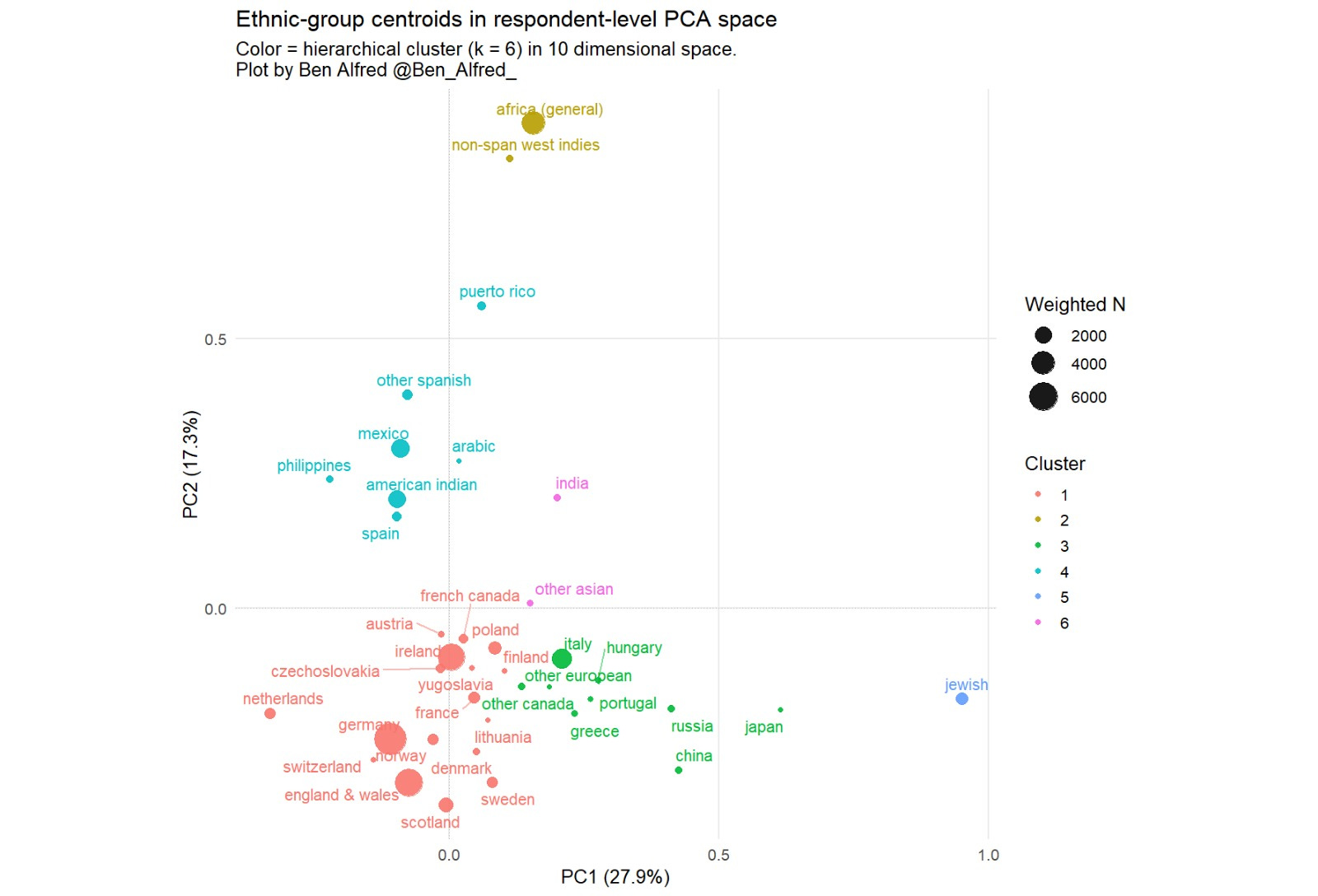
Lastly, since the interview itself didn’t provide any visuals, here’s the updated ancestry-politics PCA I was referring to:
P.S.—I will be busy in the coming months, so it will be a while until I can write and publish new articles for the blog (I don’t have an exact date for this). However, I will still be assisting the other writers on the team in revising theirs and publishing them.
Open-border libertarians routinely denounce government spending as inefficient and wasteful—except, of course, when that very inefficiency conveniently serves as a rationale for pushing for more immigration.
Did you use a voice changer? Are you a woman?
One thing I've noticed in public school budgets is they have no connection to enrollment. Many depopulating northern school districts are spending more money on fewer students.
The primary driver of government spending is political. If the Democratic Party is in charge it makes sure the budget for the teachers union goes up by X%, regardless of enrollment. Immigrants, even if childless, increase educational expenditure because their votes give Democrats power.
Similarly, the defense budget is a function of politics. You would need to know what effect immigrants have on defense spending politics to know their impact.